
Intro to zines
A zine is an independently, self-published booklet, created using text, images, collage or digitally. Zines are generally not for profit and zine-making has a DIY (do-it-yourself) publishing ethos, aligning with the ethics of reusing things creatively. The word “zine” is a shortened form of the term fanzine or ‘fan magazine’. Fanzines emerged in the 1930s among fans of science fiction and have roots in the underground publications of social and political activism in the ’60s. By the ’70s, zines were popular on the punk scene to promote music, fashion and political agendas. In the ’90s, the medium was taken up by the feminist punk scene and riot grrrls. Zines were a medium to share ideas quickly and cheaply, often supporting the work of activist communities. Zines have made a revival in recent years within all kinds of social movements as an alternative to mainstream publishing.
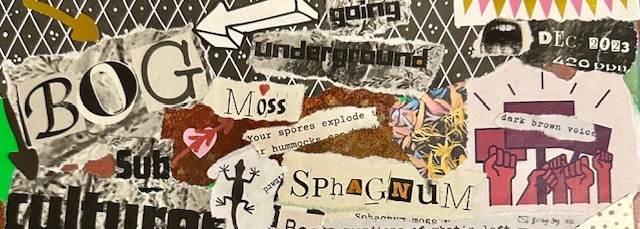
Zines and social justice
Zines can be a powerful tool for activism and advocacy, providing alternatives to corporate-owned mass media, and a way to counter its dominance. Much of what we consume in the media today is influenced by powerful agendas and interests. Social media is specifically designed to capture our attention, often in ways that disconnect us from the real world. In capitalist societies, we are constantly bombarded with advertising and images designed to manipulate and promote what the major corporations and tech companies want us to do – click, view, share, like and spend our time and money on their platforms. More ominously, some outlets want us to think and behave in ways that support their agendas.
Zines for positive peatland storytelling and creative activism
Social media has an important role to play in sharing peatland stories and messages but has also been co-opted by different groups and forces, with potential for misinformation, disinformation and the suppression of certain types of knowledge. Zine-making is a communal creative activity that enhances engagement and learning and builds community. It is a great way of engaging with young people and marginalised groups and fostering more inclusive spaces for people to learn about peatlands. The Re-Peat youth-led collective have created some great resources and a comic about peatlands, using art and educational programmes to drive societal change in how peatlands are valued. Zines are a great way to share ideas, tell stories and drive advocacy and activism in the real world. While zines started as an analog medium, they can also be shared digitally for additional accessibility. The Friends of Ardee Bog group hosted the Underground Zine Archive at their 2024 Bog Cafe including a Print Making Workshop and Pop Up Zine Fair as part of their Deep Mapping Project. Artist Kate Foster also created an online zine as part of her work with the World Soil Museum to document her experiences at the World Soil Congress. Her work complements the science and policy presentations, asking the question, “How can research meet action?”.

Zines and diverse economies
Holly Casio writes perceptively about the economy of zines: “Zines have their own economy. The art of the zine swap is a major custom of zine culture. Most zines are meant to be shared and passed on, and it’s common to see anti-copyright/copyleft disclaimers in zines encouraging readers to make and distribute their own copies of the zine to share with others. It’s part of what makes a zine, that it can exist outside of traditional publishing economies”. This ties in with the idea of Diverse Economies and the Bog Iceberg (Bogberg) created to capture the diverse economic activity and often invisible work taking place at Ireland’s peatlands. The Bogberg includes activities that could enable a transition from traditional forms of work (such as peat mining and extraction) to new forms of work that are based on an ethics of care for social and environmental wellbeing. The work of the bog itself (and its wildlife) is included in the interface between top-down management practices and community-based and grassroots endeavours.
Bog Lab and Zine Workshop at the Bog Bothy

As part of the Bog Bothy programme of events at Girley Bog, we hosted a bog lab and zine workshop on 17th August 2025. It was a really fun and informative afternoon, with peatland scientist Elena Aitova demonstrating the art of measuring water levels and taking peat cores to understand the deep interconnectedness of plants, peat soil and water in the bog. The Bog Bothy was a perfect space for coming together to learn, measure, make and have fun. Participants included artist in residence Luke Casserly, the architects behind the Bog Bothy (12th Field) and Dean Black, Placemaking Manager with the IAF, artist Fiona McDonald, and members of the Clara Heritage Group (previous custodians of the Bog Bothy). The bog zines were made by workshop participants in less than an hour and reflect a shift in what it means to ‘work on the bog.’ Once defined by physical labour, the bog is now also a space for creative work, storytelling, and community – less turf-cutting, more cutting and pasting! Check out our zine makers with their fabulous bog-inspired zines. Huge thanks to all the staff at the Irish Architecture Foundation for supporting us to host this event and to architects 12th Field for creating such an inspiring space.

Bog Subcultures Zine
As part of the Arts Council-funded collaborative project Gnáthóga Nádúrtha (GN), led by Carlow County Council Arts Office and Meath and Kildare Arts Offices, I produced a zine called ‘Bog Subcultures’, which featured in Distro: The Reading Room COMMUNE exhibition by Muine Bheag Arts, which showcased zines in a rural setting. It also featured at the 2025 Drogheda Zine Fair. The second issue profiles a handful of the many Peatland Early Career Researchers in Ireland, sharing insights, fun and practical wisdom from their work.
Bog Subcultures – Issue 1: We’re going underground
Bog Subcultures – Issue 2: Peatland research

I am very grateful to Meath County Council Arts Office and Creative Ireland for awarding me a Professional Artists Development Fund (2025) to develop this work and create more issues of the zine to highlight some of the less visible types of work, advocacy and activism happening in Ireland’s peatland landscapes. I am also deeply grateful to the GN community, including the support from Arts Office staff in each county, and Jules Michael, Monica de Bath, Cathy Fitzgerald and Anita McKeown, for the ongoing encouragement, inspiration and friendship they so generously share.
If readers have other examples of peatland-related zines for the resources section, please get in touch.
Resources
Reimagining peatlands zine by Re-peat

 A Bog's Life